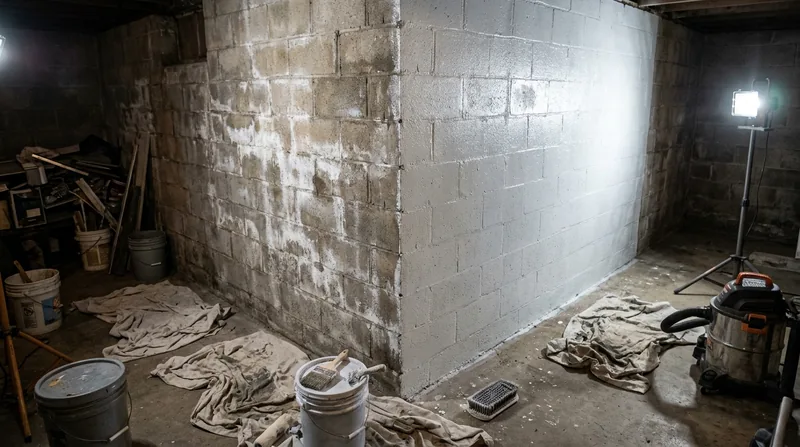




If you own one of the early brick houses downtown, in Midtown, or over in the Belle Grove district, you already know the pattern: heavy spring rain, then a damp chalky band creeping up the cellar wall. Basement Wall Sealing in Fort Smith starts with an honest look at what is actually pushing that moisture through the masonry. Our ground here is shale-derived clay over alluvium. It swells, holds water for days after a storm, and releases it slowly against old stone and brick walls that were never built for today's runoff. We prep the surface, strip the efflorescence, and apply the right penetrating or membrane sealer for your wall type. We also tell you plainly when a sealer is the wrong answer and hydrostatic pressure is the real problem. That distinction is the whole job. Call Fort Smith Waterproofing at (479) 755-9567 to get a free inspection and a straight answer.
Why Damp Basement Walls Are a Fort Smith Problem, Not a Generic One
Most of the metro sits on slab or raised pier foundations, so the basements we see are concentrated in the older housing stock: partial cellars under 1900s to 1940s brick homes, stone-and-brick walls in Midtown and Belle Grove, and a handful of walkout basements on the hillside lots around Chaffee Crossing. Those walls were parged with a thin mortar coat, not a modern waterproof membrane. When the clay stays wet and the water table rises after a hard spring storm, moisture wicks through the brick and shows up as efflorescence, peeling paint, and a musty smell that never quite leaves.
- Efflorescence blooms on the interior face after every soaking rain, which tells you water is moving through the wall, not just condensing on it.
- Old parging on Belle Grove cellars cracks and dusts off, leaving the brick exposed to direct wetting.
- Downspouts that dump within a few feet of the foundation push roof runoff straight into the same clay that is already saturated.
- Slopes in the Ozark foothills shed runoff onto low lots, so a wall can stay wet for days after the sky clears.
- Winter ice storms drive freeze-thaw cycles that open hairline cracks in mortar joints and spalling brick faces.
Sealing addresses the dampness and the surface decay. It does not stop a wall that is being pushed from the outside, and we will say so on the inspection.
Key info: A 1920s brick cellar in Midtown with a white salt bloom and peeling paint is usually a sealer and drainage-correction job. The same wall with water actually running in at the floor joint after a storm is a hydrostatic pressure problem, and a sealer alone will fail within a season.
For the official word on what work requires a permit in our area, start with the City of Fort Smith building department. Rules vary by jurisdiction and thresholds change, so verify before any structural or drainage work begins.
How We Seal a Basement Wall in Fort Smith, Step by Step
We do not sell a sealer and walk away. The prep work is what makes the coating last, and the diagnosis is what makes the prep work correct. On a typical Fort Smith job we start by finding out where the water is coming from, then we build the surface so the product can bond to sound masonry instead of dust and old paint.
- We walk the basement and the exterior grade, checking for efflorescence, wall seepage patterns, crack locations, and where the downspouts discharge.
- We wire-brush and scrape loose parging, failing paint, and mortar dust off the wall face.
- We remove efflorescence with a proper masonry cleaner and let the wall dry to a sound, absorbent surface.
- We fill hairline cracks and mortar joints with a hydraulic cement or patching mortar before any coating goes on.
- We apply the sealer: a penetrating silicate on sound brick and stone, or a flexible membrane on walls that need a bridged, monolithic film.
- We correct the grading and extend downspouts so the wall is not being re-wetted from the roof.
If the inspection shows active hydrostatic pressure, we stop and explain the alternatives instead of coating over a problem that will return.
Key info: On a 1950s brick ranch off Rogers Avenue, the wall was dry except for a two-foot band above the floor. That pattern pointed to water wicking up from the footing, not a failed coating. We sealed the upper wall, then ran a interior drain tile system along the perimeter to relieve the pressure at the base.
Sealing Methods We Use and When Each One Fits
| Approach | Description | Best for |
|---|---|---|
| Penetrating silicate sealer | Soaks into the brick or stone and reacts with the masonry to block capillary uptake without trapping vapor. | Sound brick and stone walls with dampness and efflorescence but no running water. |
| Flexible waterproof membrane | A trowel or spray applied film that bridges hairline cracks and seals the wall face as one continuous layer. | Poured concrete walls and masonry with minor cracking that needs a bridged film. |
| Crack injection plus sealing | Epoxy or polyurethane injection fills the crack from the inside, then the wall face is sealed around it. | Walls with a defined vertical or diagonal crack that seeps after rain. |
| Parging repair and reseal | We rebuild the failed mortar coat, then seal over sound parging to restore a uniform surface. | Old cellars where the original parging has cracked, dusted, or fallen away. |
| Drainage correction with sealing | Sealer plus regrading and downspout extensions to stop the wall from being re-wetted from above. | Walls that stay damp because runoff is being dumped against the foundation. |
The right row in that table depends on what the wall is doing, not on what is easiest to sell. We pick the method after the inspection.
Basement Wall Sealing Cost in Fort Smith: What to Expect
Pricing starts at $1,500 for a straightforward sealing job on a sound wall with normal prep, and that figure is a starting point, not a ceiling. A single small cellar wall with light efflorescence sits near that number. A full perimeter on a stone-and-brick Belle Grove cellar with failed parging, heavy salt bloom, and a crack that needs injection moves up from there, because prep time and material volume both climb. Access matters too: a tight basement stair and a low ceiling slow the work down, and so does furniture that has to be moved and protected.
Two or three estimates is the smart play in this market. Ask each contractor what they found on the wall, which method they recommend, and why. If one bid is a coat of paint-grade sealer and another is injection plus drainage correction, you are looking at two different diagnoses, not two prices for the same job. Our full breakdown of line items and what moves the number is on the pricing page, and the free inspection is where we confirm which scope your wall actually needs.
Hiring a Basement Wall Sealing Contractor Near Me in Fort Smith
The homeowner's job here is to separate a waterproofing specialist from a general handyman with a sealer bucket. Ask for the license and insurance certificate, confirm the company carries liability and workers' compensation coverage, and get the scope in writing with the method named. Then call a couple of recent references and ask whether the wall stayed dry through a spring storm, not just whether the crew was polite. If the wall needs structural work or a drainage alteration, ask who pulls the permit and confirm the local building department's requirements before anyone starts.
Reach us through the contact page or at (479) 755-9567 to set up the free inspection.
Basement Wall Sealing in Fort Smith: Pricing Guide
| Service | Price | Details |
|---|---|---|
| Single wall sealing, standard prep | Starting at $1,500 | Includes surface prep, efflorescence removal, and one coat of sealer on a sound wall. |
| Full perimeter sealing, older masonry | Starting at $2,400 | Covers stone and brick walls with failed parging and heavy salt bloom, priced by wall length. |
| Crack injection plus wall sealing | Starting at $1,900 | Epoxy or polyurethane injection on a seeping crack, then a sealed wall face around it. |
| Sealing with drainage correction | On estimate | Regrading and downspout extensions vary by lot, so the scope needs an on-site look first. |
| Travel | Included | In Fort Smith and surrounding areas, no separate call-out or mileage fee. |
| Estimate | Free | Response within 24h at (479) 755-9567, no obligation to book. |
Indicative pricing, the exact cost depends on square footage, finish, and site access. Free personalized estimate within 24h at (479) 755-9567.


