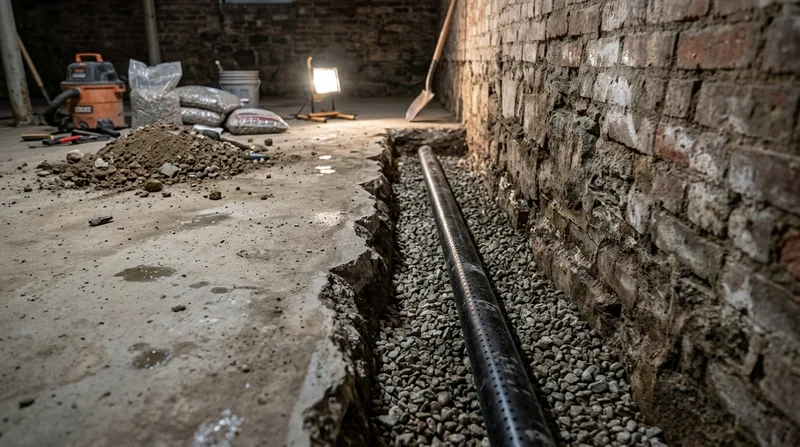




Fort Smith sits where the Arkansas River meets the Ozark foothills, and the ground under most of this city is shale-derived clay over alluvium. That clay swells after every spring storm, holds water against the foundation, and pushes it through the slab edge and the footing joint. If you are dealing with water in your basement after rain, or a wet basement that never seems to dry out, an Interior Drain Tile System in Fort Smith is the fix that works with the ground you actually have. We cut the slab perimeter, capture water at the footing, and route it to a sump basin that pumps it out and away from the house. It is the proven answer for heavy clay that keeps water trapped under the floor. Start with a free basement inspection so we can confirm the source before anyone quotes a number.
Why Fort Smith Basements Stay Wet: Clay, Slopes, and Old Brick
Fort Smith basements are uncommon, which is exactly why the ones that exist are so often wet. The 1900s-1940s brick houses downtown, in Midtown, and in the Belle Grove district have partial cellars with stone and brick walls that were never built with a footing drain. The 1990s-2010s walkout basements on the hillside lots around Chaffee Crossing and in Barling and Greenwood catch runoff from slopes above them. In both cases, the water arrives at the footing through hydrostatic pressure, not through a single visible crack.
- Heavy clay soil stays saturated for days after a hard storm and keeps pressure on the wall base.
- Older stone and brick cellars in Midtown and Belle Grove have no drain tile at all, so water pools at the footing.
- Hillside walkout basements in Greenwood and Barling take runoff from the slope above the uphill wall.
- Low lots near the Arkansas River floodplain flats downtown sit close to a high water table after spring rain.
- Ice storms and freeze-thaw cycles open footing joints and widen existing wall seepage.
When the water is coming up through the floor and the cove joint, no amount of wall sealing will stop it. That is the point where an interior perimeter drain is the right tool.
Key info: A 1920s brick house in the Belle Grove district with a stone cellar wall and water rising through the floor joint is a textbook interior drain tile case. A single hairline crack in a slab ranch in Jenny Lind is not, and we will tell you so.
Permits for work that alters drainage or the sanitary connection of a sump discharge vary by jurisdiction, so always confirm the current requirement with the City of Fort Smith Building Department before work begins. Their permit information is at fortsmithar.gov.
How We Install an Interior Drain Tile System in Fort Smith
We do not guess at the water source. On a typical Fort Smith job we open the floor at the perimeter, confirm the footing depth and the soil condition, and build the system around what is actually there. In older downtown houses, that often means working carefully around a stone footing that sits shallower than expected. In the newer walkout basements on the Chaffee Crossing hillsides, it means tying the interior drain into a sump basin sized for the runoff volume.
- We inspect the basement, the wall base, and the exterior grade to confirm the water is coming from below and not from a downspout dumping at the corner.
- We saw-cut a channel in the slab edge around the interior perimeter and remove the concrete.
- We excavate down to the footing and clean out the clay and debris.
- We set perforated drain tile in washed gravel along the footing, with the holes facing down.
- We install the sump basin at the low point and connect the drain tile to it.
- We pour new concrete over the channel and finish it flush with the existing slab.
- We install the sump pump, check valve, and discharge line, then test the system with water before we leave.
Every system gets a transferable warranty, and we walk you through the discharge point so you know where the water leaves the house.
Key info: On a 1960s brick ranch off Rogers Avenue with a shallow footing and a wet floor joint, we ran the interior perimeter drain to a sump basin at the low corner and tied in a battery backup sump pump so the system keeps working through the spring storms that knock out power in this part of Sebastian County.
Interior Drain Tile System Options We Install
Not every wet basement needs the same configuration. The right approach depends on the wall material, the footing depth, and how much water the site takes on. Here is how the main options compare for Fort Smith conditions.
| Approach | Description | Best for |
|---|---|---|
| Full interior perimeter drain | Drain tile set at the footing around the entire interior perimeter, feeding a sump basin. | Water rising through the floor joint across multiple walls, common in older brick cellars downtown. |
| Partial interior drain | Drain tile along one or two wet walls only, tied to a sump basin. | A single uphill wall taking slope runoff, typical of walkout basements in Greenwood and Barling. |
| Interior drain with dimple board | Drain tile plus dimple board on the wall to channel seepage down to the footing. | Stone and brick walls in Midtown that weep through the mortar as well as the floor joint. |
| Drain tile with sump and backup | Full perimeter drain, sump basin, primary pump, and battery backup pump. | Homes that lose power in ice storms or spring squalls and cannot afford a pump failure. |
| Drain tile repair and replacement | Replacing failed or clogged existing drain tile and reconnecting it to the sump. | Basements that already have a system but still take on water after rain. |
We size the system to the water volume the site actually produces, not to a one-size template.
Interior Drain Tile System Cost in Fort Smith: What to Expect
Most interior drain tile work in the Fort Smith area starts at From $50/linear ft, and that figure covers the saw-cut, excavation, gravel, drain tile, and concrete patch along the run. The final number depends on the linear footage, the footing depth, whether the wall is stone, brick, or poured concrete, and whether the job needs a new sump basin or a backup pump. Access matters too: a narrow cellar stair in a Belle Grove house takes more labor than an open walkout basement in Chaffee Crossing.
We recommend getting two or three written estimates before you commit. Ask each contractor to state the linear footage, the sump basin size, and whether the discharge line is included. A low bid that leaves out the sump or the concrete patch is not a lower price, it is a smaller job. Our full pricing overview lays out how the line items break down.
Interior Drain Tile System Near Me: How to Vet a Fort Smith Contractor
Searching for an interior drain tile system near me in Fort Smith turns up plenty of names, and not all of them specialize in below-grade water. A general foundation-repair firm and a plumber are not the same as a waterproofing specialist, and the diagnosis matters as much as the install. Here is what to check before you sign anything.
- Confirm the contractor is licensed and insured, and ask for a certificate of insurance before work starts.
- Get at least two written estimates and compare the linear footage and sump specifications, not just the bottom line.
- Ask for local references from basements similar to yours, whether a stone cellar downtown or a walkout in Barling.
- Ask who pulls the permit if the work alters drainage or the sump discharge connection, and confirm the requirement with the City of Fort Smith Building Department.
- Check for any HOA rules on discharge location or exterior work before the crew arrives.
If a contractor cannot explain why your basement is wet in plain terms, keep looking. Reach us through the contact page and we will tell you honestly whether you need a drain tile system or a simpler repair.
When an Interior Drain Is the Right Answer, and When It Is Not
Not every wet basement needs a perimeter drain. If the water is entering through one vertical crack in a poured wall, epoxy or polyurethane injection is often enough and costs far less. If the water is rising through the floor joint and the cove across the whole basement, injection will not touch it, and an interior drain tile system is the correct fix. We check the exterior grade and downspouts first, because a downspout dumping at the corner of a Rogers Avenue ranch can imitate a footing problem.
For walls that are bowing as well as wet, the water is only part of the story, and bowing wall repair has to come first. For basements where the walls weep but the floor stays dry, basement wall sealing and a vapor barrier may be the better spend. We will say so plainly rather than sell you a system you do not need.
Call (479) 755-9567 to schedule a free inspection. We serve Fort Smith and the surrounding towns, and we can install an interior drain tile system in any season, rain or shine.
Interior Drain Tile System in Fort Smith: Pricing Guide
| Service | Price | Details |
|---|---|---|
| Partial interior drain (one or two walls) | Starting at $50/linear ft | Includes saw-cut, excavation, gravel, drain tile, and concrete patch along the run. |
| Full interior perimeter drain | Starting at $50/linear ft | Full perimeter run, priced by total footage, footing depth, and wall material. |
| Drain tile with sump basin and pump | On estimate | Adds sump basin, primary pump, check valve, and discharge line sized to the site. |
| Drain tile with battery backup pump | On estimate | Adds a battery backup pump for storm-season power outages, quoted after inspection. |
| Travel | Included | In Fort Smith and surrounding areas, no separate call-out or mileage fee. |
| Estimate | Free | Response within 24h at (479) 755-9567, no obligation to book. |
Indicative pricing, the exact cost depends on square footage, finish, and site access. Free personalized estimate within 24h at (479) 755-9567.


