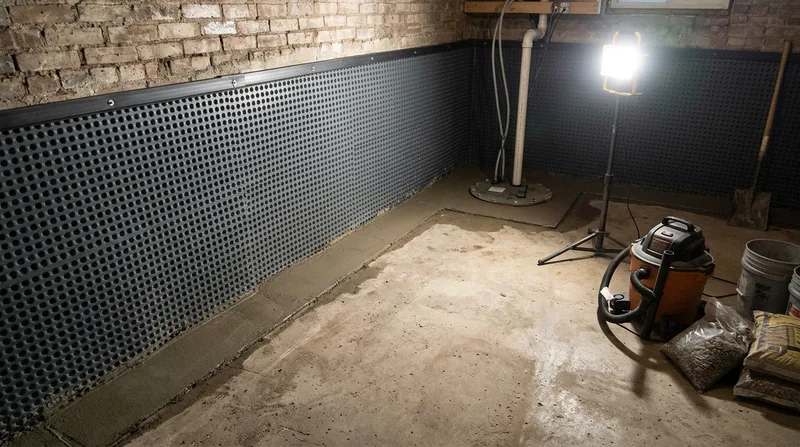




Why Basement Waterproofing in Fort Smith Is Different From Anywhere Else
If you own one of the 1900s-1940s brick houses downtown, in Midtown, or in Belle Grove, you already know the pattern: heavy spring rain, then water weeping through the stone and brick walls of that early basement or partial cellar. Basement Waterproofing in Fort Smith starts with the ground, not the wall. Our shale-derived clay over alluvium holds water for days after a storm, and that saturated clay pushes against your foundation with real hydrostatic pressure.
Most of the metro sits on slab or raised pier foundations, so the work here is rarely a full basement dig. It is sump pumps that quit during a storm, French drains that clog, foundation cracks that open, window wells that fill, and grading that sends runoff straight to the low side of the house. We handle interior drain tile systems and the below-grade work that actually stops water at the source.
Fort Smith Clay, River Flats, and Hillside Lots: Why Water Finds Your Basement
The failure mode that dominates Fort Smith is not a single cracked wall. It is saturated clay soil that cannot drain, combined with slopes that shed runoff onto low lots and creeks that flash after hard storms. Downtown near the Arkansas River floodplain, the water table sits high and stays high. On the hillside walkouts around Chaffee Crossing and in Greenwood, water moves fast downslope and finds the footing.
- Hydrostatic pressure builds against basement walls after two or three days of spring rain, and the wall cracks at the weakest joint.
- Water table rise in the river flats pushes seepage through the floor joint and up through the slab.
- Early stone and brick walls in Midtown and Belle Grove wick moisture, leaving white efflorescence and a musty basement smell.
- Ice storms and freeze-thaw cycles open existing cracks wider each winter, even when the basement stays dry in summer.
Each of these needs a different answer, and guessing wrong is how homeowners end up paying twice.
Key info: A homeowner in the 72903 area had water on the floor every April and blamed a hairline crack. The real problem was a clogged footing drain and a sump pump that had failed silently. Sealing the crack would have done nothing. We ran the water path first.
Permits for structural foundation repair and work that alters drainage vary by jurisdiction, so always confirm with the City of Fort Smith building department before work begins. You can review the city's permit resources at fortsmithar.gov.
How We Trace and Stop Water in Fort Smith Basements
We do not sell a system before we know where the water comes from. A free basement inspection starts with the water path: where it enters, how it moves, and what is pushing it. Then we build the smallest system that solves the actual problem, whether that is crack injection, an interior perimeter drain, or grading and downspout correction.
- We walk the exterior first, checking grading, downspout extension, window wells, and any sign of a failed footing drain.
- We inspect the basement walls and floor joint for seepage, efflorescence, and the height of the last water line.
- We test the sump pump and check valve, because a dead pump turns a manageable seep into a flooded floor.
- We recommend the fix: epoxy or polyurethane injection for an active crack, interior drain tile for hydrostatic pressure, or exterior membrane where the wall itself is failing.
- We pull permits where required and schedule the work around the weather window.
Every recommendation comes with a plain answer about what is necessary and what can wait.
Key info: A 1960s brick ranch off Rogers Avenue had a wet floor joint after every hard storm and a sump basin that ran dry. The cause was a cracked clay tile footing drain. We replaced the drain tile and tied it to a new sump basin with a battery backup, and the floor stayed dry through the next spring.
For interior work, see our Basement Waterproofing in Fort Smith 72903 page for neighborhood-specific detail.
Waterproofing Methods We Use Below Grade
Not every wet basement needs the same approach. The table below shows what each method does and when it is the right call in Fort Smith's clay and alluvium soils.
| Approach | Description | Best for |
|---|---|---|
| Interior drain tile system | Perimeter drain cut into the floor along the footing, leading to a sump basin. | Hydrostatic pressure and water at the floor joint. |
| Sump pump and battery backup | Primary pump with check valve and a battery backup for storm outages. | Any basement with a sump basin, especially during spring storms. |
| Epoxy or polyurethane injection | Injection ports seal an active crack from the inside. | A single leaking crack in a poured or brick wall. |
| Exterior waterproofing | Membrane and dimple board applied to the outside of the wall with drainage. | Walls that are bowing or failing and need excavation. |
| Grading and downspout correction | Reshaping soil and extending downspouts away from the foundation. | Runoff from slopes and roof water reaching the wall. |
We match the method to the water path, not to a sales package.
Basement Waterproofing Cost in Fort Smith: What to Expect
Homeowners ask for a price before we see the basement, and that is fair. The honest answer is that Basement Waterproofing cost in Fort Smith depends on the water path, the wall type, and the access. A single crack injection and a full interior perimeter drain are not the same job, and we will not quote one as the other.
As a starting point, most of our work begins From $2,500. That figure covers a straightforward interior drain tile run with a sump pump in a typical Fort Smith basement. The number moves up with linear footage, wall condition, whether the footing drain needs replacement, and whether we are working in a tight Midtown cellar or a walkout on a Greenwood hillside.
We recommend getting two or three estimates and comparing the scope, not just the total. A low number that skips the sump pump or the discharge line is not a lower price, it is a smaller job. Our full pricing overview breaks down the ranges by method.
Choosing a Basement Waterproofing Contractor Near Fort Smith
Waterproofing is below-grade work, so you cannot inspect it easily after the fact. That makes the contractor choice more important than the price. Ask direct questions and expect direct answers.
- Confirm the company is licensed and insured, and ask for a certificate of insurance before work starts.
- Get at least two or three written estimates that describe the same scope so you can compare fairly.
- Ask for local references from jobs in Fort Smith, Van Buren, or Barling and call them.
- Ask who pulls the permit when structural repair or egress work is involved, and verify the rule with the city building department.
- Check whether your neighborhood or HOA has requirements for exterior excavation or discharge routing before the crew arrives.
A contractor who explains when simple crack sealing is enough is the one worth hiring. Reach us through our contact page to schedule a free inspection.
Basement Waterproofing in Fort Smith: Pricing Guide
| Service | Price | Details |
|---|---|---|
| Crack injection (epoxy or polyurethane) | Starting at $2,500 | Includes injection ports and sealing of an active crack, priced by crack length and wall type |
| Interior drain tile and sump pump | Starting at $2,500 | Perimeter drain, sump basin, pump and check valve, priced by linear footage and access |
| Exterior waterproofing with membrane | On estimate | Excavation, membrane, dimple board and drainage require an on-site look before quoting |
| Grading and downspout correction | Starting at $2,500 | Reshaping soil and extending downspouts, priced by run length and slope |
| Travel | Included | in Fort Smith and surrounding areas, no separate call-out or mileage fee |
| Estimate | Free | Response within 24h at (479) 755-9567, no obligation to book |
Indicative pricing, the exact cost depends on square footage, finish, and site access. Free personalized estimate within 24h at (479) 755-9567.


