



Bowing Wall Repair in Fort Smith: When Wet Clay Pushes Back
If you own one of the older brick houses downtown, in Midtown, or in the Belle Grove district, you already know the ground here moves. Fort Smith sits on shale-derived clay over alluvium, and that clay swells hard after every spring rain, then shrinks in the summer heat. When a stone or block foundation wall has to hold that pressure back year after year, it starts to lean, bow inward, and crack along the mortar joints. That is where Bowing Wall Repair in Fort Smith comes in, and it is a different job from sealing a hairline crack.
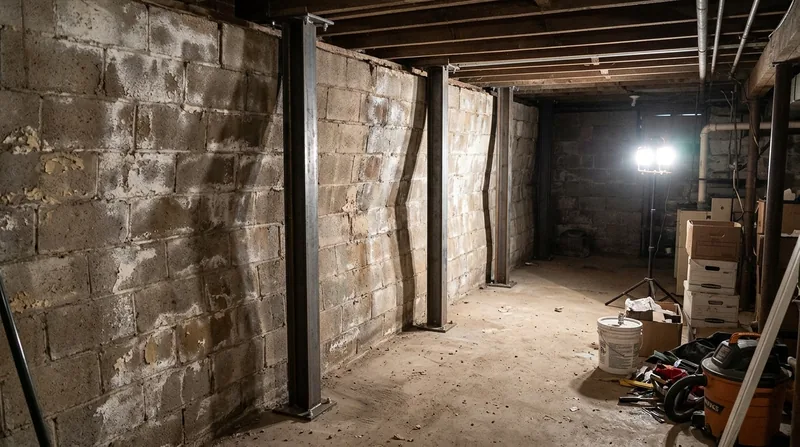
We stabilize the wall, not just the crack. Carbon fiber straps, steel I-beams, or wall anchors get matched to how far the wall has moved and how much wet clay is pressing on it. If you are still at the seepage stage and the wall is straight, start with foundation crack repair and save the structural work for when you actually need it.
Why Bowing Walls Show Up in Fort Smith's Older Basements
Most of the bowing walls we look at are in pre-1950 stone and brick foundations, the ones under the older homes near the river and through Midtown. Those walls were laid without modern drainage, so the footing drain is either clogged with clay or was never there. Water builds up behind the wall, hydrostatic pressure loads it, and the wall deflects inward at mid-height. You see the tell in a vertical crack that widens toward the top, a wall that is plumb at the floor and out of plumb at the sill, or a horizontal crack running along a block course.
- You notice efflorescence, that white salt bloom, on the inside face after a wet spring.
- The wall bulges inward more than an inch over its height, which is past cosmetic.
- Doors and windows above the wall start sticking because the frame is racking.
- Mortar joints in a stone wall step and open as the wall rotates.
- A block wall shows a stair-step crack following the mortar lines.
Any one of these means the wall is carrying load it was never designed to carry, and patching the crack alone will not stop the movement.
Key info: A 1920s brick house in Belle Grove with a stone cellar wall that bowed after the spring rains is a textbook case. The clay stayed saturated for weeks, the wall pushed in about an inch and a half, and the fix was carbon fiber straps plus a drainage correction, not a new wall.
For the official word on what structural foundation work needs a permit in this jurisdiction, check with the City of Fort Smith building department before any wall stabilization begins: fortsmithar.gov.
How We Repair a Bowing Wall in Fort Smith, Step by Step
We start by reading the wall, not by selling a system. The first question is whether the wall is still moving or has settled into a stable position, because a stable wall and an active one get different repairs. We check plumb with a level, map the cracks, and look at the drainage on the outside, since wet clay is usually the driver. Then we match the method to the severity.
- We inspect the wall, the floor joint, and the soil side to confirm the direction and amount of movement.
- We correct the water source first with grading, downspout extensions, or a footing drain so the pressure stops building.
- We install carbon fiber straps on block and brick walls where the movement is moderate and the wall is still sound.
- We set steel I-beams against the wall and into the footing for heavier loads or badly cracked walls.
- We drive wall anchors through the soil to the outside and tie the wall back when excavation is not practical.
- We seal the cracks with epoxy or polyurethane injection and finish the inside face so you can monitor it.
Each method has a job it does best, and we tell you plainly when a cheaper repair is enough and when it is not.
Key info: On a 1960s brick ranch off Rogers Avenue, the wall had a horizontal crack at mid-height and about an inch of bow. We used carbon fiber straps because the wall was still straight enough to stabilize, and we extended the downspouts to stop the clay from loading it again. No excavation, no wall replacement.
If the inspection shows the water problem is broader than one wall, the right next step is often an interior drain tile system that takes the water off the footing before it ever reaches the wall.
Methods We Use for Bowing Wall Repair in Fort Smith
| Approach | Description | Best for |
|---|---|---|
| Carbon fiber straps | Straps epoxied to the inside face and anchored top and bottom to resist further inward movement. | Moderate bow in block or brick walls that are still structurally sound. |
| Steel I-beams | Vertical steel beams set against the wall and tied into the floor and footing to carry the load. | Heavy bow, wide cracks, or walls carrying significant clay pressure. |
| Wall anchors | Plates on the inside tied to anchors driven into stable soil outside to pull the wall back. | Walls where outside excavation is not practical or the yard must stay intact. |
| Crack injection | Epoxy or polyurethane injected through ports to fill and seal the crack after stabilization. | Sealing the cracks that remain once the wall has stopped moving. |
| Drainage correction | Grading, downspout extensions, and footing drain work to relieve hydrostatic pressure. | Every bowing wall, because wet clay is what drives the movement. |
Bowing Wall Repair Cost in Fort Smith: What to Expect
Pricing for bowing wall repair starts at $600 for a limited stabilization or crack injection scope, and climbs from there with the method and the length of wall involved. Carbon fiber straps on a short wall sit at the low end. Steel I-beams, wall anchors, or a full drainage correction push the number up because of materials, labor, and the excavation or drilling involved. The number that matters is the one tied to your wall, not a phone quote.
What moves the price: how far the wall has bowed, whether it is stone, block, or poured concrete, how many linear feet need stabilizing, whether the footing drain has to be corrected, and how tight the access is in an older basement. Getting two or three estimates is smart because the diagnosis should match the repair, and a contractor who quotes a wall replacement for a wall that only needs straps is telling you something. See the full pricing overview for the range of scopes we handle.
Key info: A homeowner in Van Buren was quoted a full wall replacement by one firm. The wall had bowed about three quarters of an inch and was stable. Carbon fiber straps plus downspout extensions did the job for a fraction of that number, and we told them so before they signed anything.
Bowing Wall Repair Near Me: How to Hire in the Fort Smith Area
Bowing wall work is structural, so the contractor you hire matters more than the price tag. Ask for proof of licensing and insurance before anyone touches the wall, and get a written scope that names the method and the reason for it. Check references on similar stone or block walls, not just on new construction. And confirm who pulls the permit, because structural foundation repair commonly requires one here and the rules vary by jurisdiction. Call us at (479) 755-9567 or request a free estimate and we will walk the wall with you.
One more thing worth knowing: a contractor who cannot explain why your wall is bowing, in plain terms about clay and water, is guessing. The right answer always starts with the water.
Bowing Wall Repair in Fort Smith: Pricing Guide
| Service | Price | Details |
|---|---|---|
| Crack injection and sealing | Starting at $600 | Covers epoxy or polyurethane injection on accessible cracks, priced by linear feet and wall condition. |
| Carbon fiber strap stabilization | Starting at $1,200 | Straps anchored top and bottom on a moderate bow, priced by number of straps and wall length. |
| Steel I-beam or wall anchor system | On estimate | Heavy bow or wide cracks need an on-site look to size beams, anchors, and footing tie-ins. |
| Drainage correction add-on | Starting at $800 | Grading, downspout extensions, or footing drain work to relieve the clay pressure driving the bow. |
| Travel | Included | In Fort Smith and surrounding areas, no separate call-out or mileage fee. |
| Estimate | Free | Response within 24h at (479) 755-9567, no obligation to book. |
Indicative pricing, the exact cost depends on square footage, finish, and site access. Free personalized estimate within 24h at (479) 755-9567.


