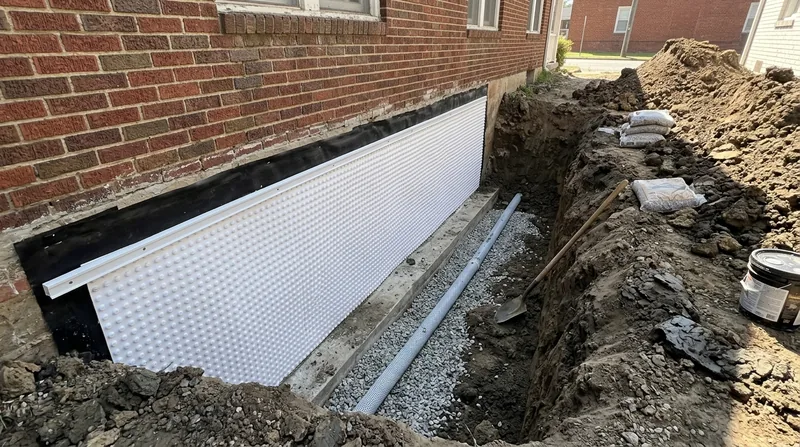




Fort Smith sits in the Arkansas River valley where shale-derived clay soils stay saturated long after spring storms pass through. In older neighborhoods like Belle Grove and Midtown, 1900s brick houses often have partial cellars with stone or brick walls that seep when the water table rises. West of Rogers Avenue, the 1950s and 1960s brick ranches sit on slab or raised piers, and hillside lots around Chaffee Crossing shed runoff straight toward low foundations. That is why Exterior Basement Waterproofing in Fort Smith starts with the soil outside the wall, not with a bucket inside. We excavate down to the footing, apply a waterproof membrane or dimple board directly to the foundation wall, correct the grading, and extend the downspouts away from the house. If you are still comparing approaches, start with our basement waterproofing service page to see how exterior work fits with the rest of the system.
Why Exterior Waterproofing Matters on Fort Smith's Clay Soils
The clay over alluvium in the Fort Smith metro holds water like a sponge and releases it slowly against your foundation wall. Hydrostatic pressure builds after every hard rain, and that pressure finds the weakest point: a cold joint, a hairline crack, or porous mortar in an old brick cellar wall. Creeks around the city flash fast, and lots that slope toward the river floodplain push runoff onto low foundations near the old downtown. Exterior waterproofing relieves that pressure at the source instead of letting it push through the wall.
- Heavy clay keeps the soil against your wall wet for days after a storm, so seepage returns with each rain.
- Downspouts that dump at the foundation corner send roof runoff straight into the same clay.
- Older brick and stone cellar walls in Midtown absorb water and show efflorescence as salts migrate through.
- Hillside lots in Barling and Greenwood shed runoff toward the low side of the foundation.
- Freeze-thaw cycles in winter open cracks that were tight in summer.
The result is a wet basement you can predict by the weather forecast, and exterior work is the way to break that cycle.
Key info: A homeowner in the Belle Grove district called us after every spring storm because water ran across the cellar floor from the back wall. The downspout ended six inches from the foundation, and the grade sloped toward the house. Correcting the grade and extending the discharge solved most of it before we ever opened the ground.
For permit questions about drainage alterations or structural work, verify requirements with the City of Fort Smith building department before work begins, because rules vary by jurisdiction.
How We Do Exterior Basement Waterproofing in Fort Smith
We start by walking the lot and reading the water. That means checking grade, downspout discharge, window wells, and the condition of the wall itself before we quote excavation. On a 1950s ranch in Jenny Lind, the answer might be grading and a membrane; on a 1920s brick cellar in Midtown, it is usually excavation to the footing and dimple board. The sequence below is the standard exterior scope we follow.
- We inspect the basement interior and the exterior grade to find where water enters and where it collects.
- We dig a trench along the foundation wall down to the footing, protecting utilities and landscaping as we go.
- We clean and parge the wall, then apply a waterproof membrane or dimple board directly against the masonry.
- We install or repair the footing drain (weeping tile) at the base of the wall to carry water away.
- We backfill with free-draining material and regrade the surface so it slopes away from the house.
- We extend downspouts and discharge lines well past the backfill zone.
Every exterior job ends with a grading check, because a perfect membrane under a flat grade still lets water sit against the wall. For hillside lots in Greenwood or Barling, we often pair the exterior scope with French drain installation to intercept runoff before it reaches the foundation.
Key info: On a walkout basement near Chaffee Crossing, the uphill side collected runoff from two neighboring lots. We excavated to the footing, applied dimple board, and tied the footing drain into a discharge line that daylights downslope. The interior stayed dry through the next spring's heavy rain.
Exterior Waterproofing Methods We Use
Not every wet wall needs the same treatment. We match the method to the wall type, the soil, and how the water is arriving. The table below shows the main exterior approaches and where each one fits in the Fort Smith area.
| Approach | Description | Best for |
|---|---|---|
| Membrane plus dimple board | Waterproof membrane applied to the wall with dimple board over it to create a drainage gap. | Brick and stone cellar walls that seep after storms. |
| Footing drain replacement | New weeping tile at the base of the wall, bedded in gravel and routed to a discharge point. | Collapsed or clogged original drain tile on older homes. |
| Grading and downspout correction | Regrade the surface to slope away and extend discharge lines past the backfill. | Slab and pier homes where runoff, not groundwater, is the source. |
| Window well drainage | Drain the well to the footing drain and cover it to keep debris out. | Basements with window wells that fill during heavy rain. |
| Interior drain tile (when exterior is not practical) | Perimeter drain inside the basement leading to a sump basin and pump. | Finished basements or tight lots where excavation is not feasible. |
We tell you plainly when exterior excavation is overkill and a sealed crack or corrected grade will do the job.
Exterior Basement Waterproofing Cost in Fort Smith: What to Expect
Most exterior waterproofing in the Fort Smith area starts around $95 per linear foot, and that figure covers excavation, wall preparation, membrane or dimple board, and backfill. The final number moves with wall length, depth to footing, soil conditions, and access. A long ranch wall in Jenny Lind with open side yards is a different job from a tight downtown lot where the excavator has to work between a fence and a driveway. Hard shale clay slows digging, and old brick walls sometimes need parging before the membrane goes on.
Get two or three estimates and compare scope, not just the bottom line. One quote may include footing drain replacement and another may not, and that difference matters more than a few dollars per foot. Our pricing page breaks down how we build an estimate.
Exterior Basement Waterproofing Near Me: Hiring a Contractor Near Fort Smith
Ask three questions before you sign anything. First, confirm the contractor is licensed and insured and ask for a certificate. Second, ask for references from jobs in Fort Smith or the surrounding towns, and call them. Third, find out who pulls the permit if the work alters drainage or touches structural elements, because the City of Fort Smith building department sets the rules and they vary by jurisdiction. Get the scope in writing, including whether footing drain replacement is included.
We are a dedicated basement waterproofing specialist, not a general foundation firm or a plumber, and we will tell you when an interior drain tile system is the better answer than exterior excavation. Reach out through our contact page to schedule a free basement inspection.
Exterior vs Interior Waterproofing: Which Fits Your Fort Smith Home
Exterior work stops water before it reaches the wall, which is why it lasts. Interior drain tile manages water that is already inside the block or behind the wall. On a 1920s brick cellar in Midtown, exterior excavation to the footing is usually the right call. On a finished basement in a 2000s subdivision in Barling, an interior drain tile system often makes more sense because it protects the finished space without tearing up the yard. We walk both options with you and quote the one that fits the house.
Exterior Basement Waterproofing in Fort Smith: Pricing Guide
| Service | Price | Details |
|---|---|---|
| Exterior membrane and dimple board | Starting at $95/linear ft | Covers excavation to footing, wall prep, membrane, and backfill; depth and access move the rate. |
| Footing drain replacement | Starting at $40/linear ft | New weeping tile bedded in gravel and routed to discharge; tied into exterior scope when opened. |
| Grading and downspout correction | Starting at $1,200 | Regrade surface slope and extend discharge lines past backfill; yard size and haul-off affect price. |
| Window well drainage | Starting at $650 per well | Drain the well to footing drain and fit a cover; depth and access to the well drive the number. |
| Complex or large-scale job | On estimate | Tight downtown lots, deep footings, or old brick walls needing parging require an on-site look. |
| Travel | Included | In Fort Smith and surrounding areas, no separate call-out or mileage fee. |
| Estimate | Free | Response within 24h at (479) 755-9567, no obligation to book. |
Indicative pricing, the exact cost depends on square footage, finish, and site access. Free personalized estimate within 24h at (479) 755-9567.


