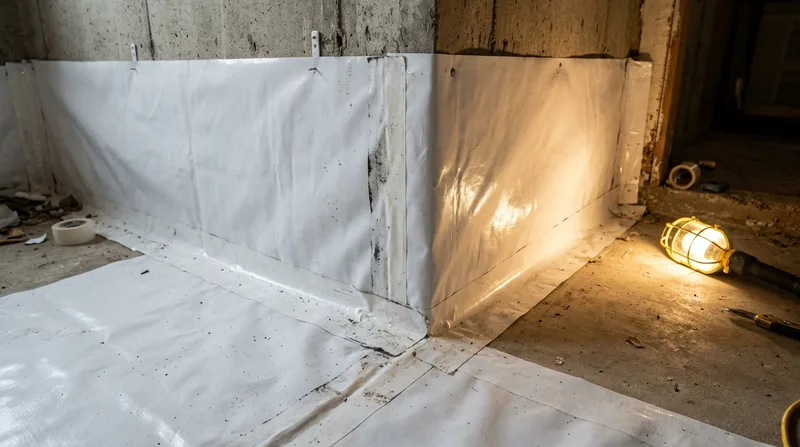




Vapor Barrier Installation in Fort Smith
When you need Vapor Barrier Installation in Fort Smith, the job is about stopping ground moisture before it ever reaches your living space. Fort Smith sits on shale-derived clay over alluvium, and that heavy clay holds water for days after a spring storm. In the older brick houses downtown, Midtown, and Belle Grove, early basements and partial cellars of stone and brick wick that moisture straight through the walls. Out in Chaffee Crossing, Barling, and Greenwood, walkout basements cut into hillside lots face the same pressure from the uphill side. We install heavy-duty vapor barrier sheets across basement walls and slabs, seal the seams, tape the terminations, and tie the system into your sump where needed. The result is a drier lower level and a basement that stops smelling like wet earth. If you want the full picture of how this fits with drainage, start with our basement waterproofing service.
Why Vapor Barrier Installation Matters in Fort Smith's Clay Soil
Fort Smith's ground is the whole story here. The clay swells when it drinks and shrinks when it dries, and it pushes moisture vapor through concrete and mortar year after year. Basements are uncommon in this metro, so the ones that exist are often in older homes with stone or brick walls that were never built with a moisture barrier. That is why we see efflorescence blooming on basement walls in Midtown and musty smells in the lower level of 1950s brick ranches off Rogers Avenue. A vapor barrier installed correctly blocks that vapor at the surface instead of letting it condense on cool walls.
- The heavy clay stays wet long after rain, so vapor keeps driving inward for days.
- Older stone and brick basement walls are porous and pull moisture straight through the mortar.
- Hillside walkout basements in Greenwood and Barling collect moisture from the uphill grade.
- Arkansas River floodplain flats near the old downtown sit on a high water table after hard storms.
- Winter ice storms and freeze-thaw cycles open small cracks that let vapor through the wall face.
A properly sealed barrier turns a damp, sour lower level into usable dry space, and it works best when paired with drainage that moves water away from the footing.
Key info: A homeowner in the Belle Grove district had white efflorescence creeping up a stone basement wall and a musty smell every spring. The wall was not cracked and the footing drain was clear. The moisture was vapor coming through the porous stone, and a sealed wall barrier with taped terminations solved it without excavation.
For the official rules on basement and foundation work in Arkansas, check the State of Arkansas resources and confirm local requirements with the Fort Smith building department before any structural or drainage alteration.
How We Install Vapor Barriers in Fort Smith Basements
We start by finding out where the moisture is actually coming from, because a barrier over an active leak just traps water behind plastic. On a typical Fort Smith job we inspect the walls, the slab, the cove joint, and the sump, then map the seams and terminations before we cut a single sheet. The work is methodical and the details at the seams and the floor joint matter more than the sheet itself. Here is how a standard installation runs.
- We inspect the basement walls, slab, and sump and note any active seepage or crack that needs repair first.
- We clean and prep the wall and floor surfaces so the barrier and tape bond properly.
- We cut and fit heavy-duty vapor barrier sheets to the wall height and slab layout.
- We seal every seam with compatible tape and mechanical fasteners along the top termination.
- We tape the bottom termination at the cove joint and integrate the barrier with the sump basin where one is present.
- We seal penetrations around pipes, posts, and electrical boxes so vapor cannot slip past.
- We walk the job with you and explain how the barrier interacts with your drainage and sump.
The barrier is only as good as the drainage behind it, so we flag any wall that needs crack repair or a drain before the sheets go up.
Key info: In a 1960s brick ranch off Rogers Avenue, the basement slab sweated all summer and the cove joint wept after every hard rain. We repaired a hairline crack with epoxy injection first, then installed the wall and slab barrier with a taped cove termination tied to the existing sump. No excavation was needed.
If your inspection turns up a failing footing drain or a wet perimeter, our interior drain tile system is often the better answer than fighting moisture with a barrier alone.
Vapor Barrier Approaches We Use in the Fort Smith Metro
Not every basement needs the same barrier. A stone cellar wall in Midtown behaves differently from a poured walkout wall on a hillside lot in Greenwood, and the material and termination details change with it. The table below shows the main approaches we use and where each one fits. We pick the approach after the inspection, not before.
| Approach | Description | Best for |
|---|---|---|
| Wall sheet barrier | Heavy-duty sheets fastened to the wall with sealed top and bottom terminations. | Porous stone or brick walls with vapor drive and efflorescence. |
| Slab barrier | Sheet laid over the slab with taped seams and a sealed cove joint. | Sweating slabs and damp floors in older basements. |
| Wall and slab system | Full wrap with taped transitions and sump integration where a basin exists. | Whole-basement moisture control on finished or semi-finished space. |
| Dimple board drainage mat | Drainage mat against the wall that lets water fall to the footing drain. | Walls with active seepage where drainage matters more than vapor. |
| Spot barrier repair | Re-sealing failed seams, terminations, and penetrations on an existing barrier. | Barriers that have peeled or lost tape at the cove joint. |
Each approach is chosen to match the wall type and the moisture source, and we tell you plainly when a simple repair is enough.
Vapor Barrier Installation Cost in Fort Smith: What to Expect
Most Fort Smith vapor barrier work starts from $3 per square foot of treated wall and floor area, and the final number depends on the size of the basement and how much prep the surfaces need. A small partial cellar in Midtown with one damp wall sits near the low end, while a full walkout in Greenwood with sump integration and crack repair runs higher. Access matters too: a basement reached through a narrow interior stair takes more handling time than one with a wide walkout door. We do not quote from the driveway, because the details at the cove joint and the sump decide the scope.
Getting two or three estimates is smart in this market, and it lets you compare what each contractor includes at the seams and terminations. Ask whether the price covers surface prep, tape, sump integration, and disposal, because those line items are where cheap quotes hide the gaps. Our full pricing overview lays out the ranges so you can compare apples to apples before anyone shows up.
What to Look For in a Waterproofing Contractor Near Fort Smith
Vapor barrier work looks simple until a seam fails six months later, so the contractor matters as much as the material. Start by confirming the company is licensed and insured and ask for a certificate of insurance before work begins. Get two or three written estimates that spell out prep, materials, terminations, and sump integration, and check references from jobs in Fort Smith and the surrounding towns. Ask whether the crew handles crack repair and drainage or just hangs plastic, because moisture control is a system, not a sheet.
Permits can apply when work alters drainage or the sanitary connection of a sump discharge, and thresholds vary by jurisdiction, so confirm the rules with the Fort Smith building department. If your home is in a historic district like Belle Grove, check any local review requirements before exterior work. When you are ready to talk through your basement, reach out through our contact and free estimate page and we will set up an inspection.
Vapor Barrier Installation in Fort Smith: Pricing Guide
| Service | Price | Details |
|---|---|---|
| Wall sheet barrier | Starting at $3/sq ft | Includes surface prep, heavy-duty sheet, sealed top and bottom terminations, and taped seams. |
| Slab barrier | Starting at $3/sq ft | Covers slab prep, sheet layout, taped seams, and a sealed cove joint at the wall. |
| Wall and slab system with sump integration | On estimate | Full wrap with sump tie-in and penetration sealing, priced after the inspection reveals scope. |
| Barrier repair and re-sealing | On estimate | Re-taping failed seams and terminations, priced by the number of repair points. |
| Travel | Included | In Fort Smith and surrounding areas, no separate call-out or mileage fee. |
| Estimate | Free | Response within 24h at (479) 755-9567, with no obligation to book. |
Indicative pricing, the exact cost depends on square footage, finish, and site access. Free personalized estimate within 24h at (479) 755-9567.


