Why Fort Smith Basements Leak: Clay Soil and Heavy Rain
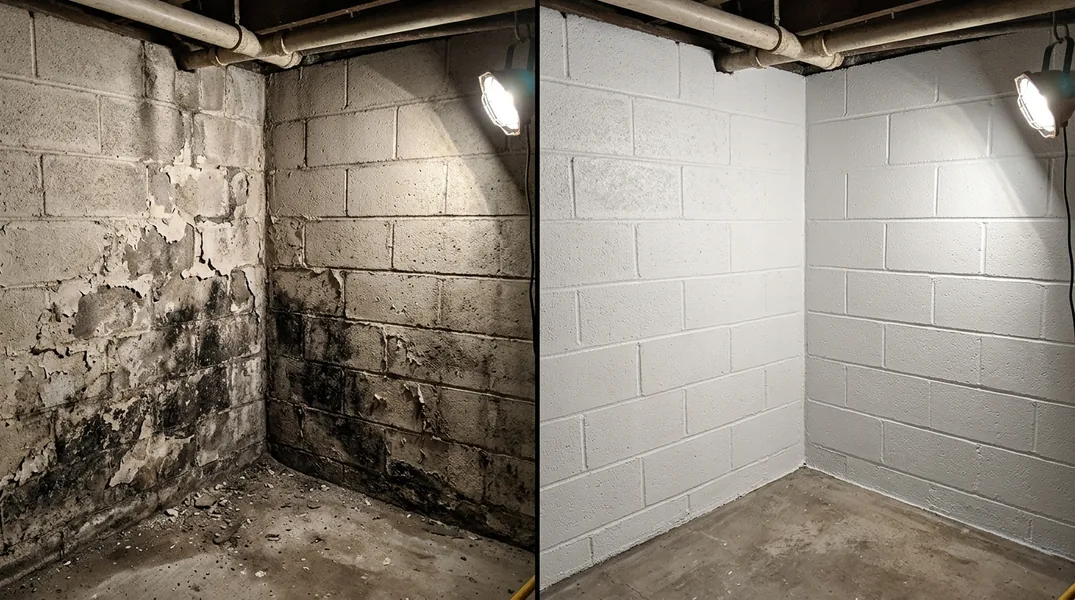
Homeowners across the Fort Smith area deal with a specific combination of problems that makes basement moisture common. The region sits on expansive clay soils that swell when wet and shrink when dry. During Arkansas spring storms, that clay absorbs water slowly, so instead of draining away, water piles up against foundation walls and pushes inward. Hydrostatic pressure builds, and the first sign is often a damp corner, a white chalky stain, or water seeping through the cove joint where the floor meets the wall.
This is why so many local basements develop leaks even when the home is otherwise well built. The issue is rarely the concrete itself. It is the water management around and beneath the slab. Understanding that helps explain why the interior vs exterior waterproofing decision is not about picking a favorite method. It is about matching the solution to how water actually behaves on your lot. Homes in low-lying areas near the Arkansas River, and neighborhoods in nearby Van Buren, often face more persistent pressure than homes on higher ground, which is why an on-site evaluation matters more than a generic checklist.
How Interior Drain Tile Systems Work
An Interior Drain Tile System is installed along the inside perimeter of the basement, typically in a channel cut into the concrete floor next to the footing. Water that enters the soil around the foundation is collected by the drain tile and routed to a sump pit, where a pump discharges it away from the home. Because the work happens indoors, there is no excavation of your yard, no disruption to landscaping, and no dependence on the weather. The system keeps working through freeze and thaw cycles and during heavy summer rain.
Interior systems are especially effective for Arkansas clay basement leaks because they relieve pressure at the point where water actually enters. They also handle water that comes up through the floor, not just through the walls. If your basement has a finished ceiling or stored belongings, the installation is contained and predictable. Most homeowners find that an interior drain tile system is the more practical choice when the goal is to keep the basement dry year round and protect finished space. It also pairs well with a vapor barrier and a dehumidifier for full moisture control.
How Exterior Basement Waterproofing Works
Exterior Basement Waterproofing takes the opposite approach. The soil around the foundation is excavated down to the footing, the wall is cleaned and repaired, and a waterproof membrane is applied to the exterior surface. A drainage board and exterior drain tile are added, and the soil is backfilled with proper grading so water flows away from the house. This method stops water before it ever reaches the wall, which can be a strong advantage when a foundation has significant structural damage or when the goal is to protect the concrete itself from long-term deterioration.
The tradeoffs are real. Exterior work is more invasive, it can disturb decks, patios, and mature landscaping, and it is generally more expensive because of the excavation. It also cannot address water that rises under the slab. In the drain tile vs exterior membrane comparison, the exterior membrane wins on source control, while the interior system wins on practicality and consistent performance in clay-heavy soil. For many Fort Smith homes, the right answer is a hybrid or a carefully chosen single approach based on the specific leak pattern.
Interior vs Exterior Waterproofing: A Side-by-Side Comparison
When homeowners ask for a waterproofing comparison, the conversation usually comes down to four factors: where the water enters, how much disruption is acceptable, how long the work takes, and what it protects. Interior systems address water after it enters the basement, which means they are highly effective at keeping the living space dry but do not stop water from contacting the exterior wall. Exterior systems stop water at the wall but require excavation and do not solve floor seepage. Neither method is universally better, and any contractor who claims otherwise is oversimplifying.
Cost is another factor, and it is worth being honest about it. Exterior excavation typically carries a higher pricing threshold because of labor, equipment, and restoration. Interior drain tile is usually more budget-friendly and faster to install. For homeowners in Barling or Greenwood who want the basement usable again quickly, interior work is often the first recommendation. The best way to decide is to have a professional trace the water path and evaluate the foundation condition before committing to either method.
Basement Waterproofing Cost in Fort Smith: What to Budget
There is no single price that fits every home, but homeowners should understand the main cost drivers. Interior drain tile pricing depends on the linear footage, the number of sump pumps, and whether a vapor barrier or dehumidifier is included. Exterior work depends on excavation depth, access, the length of wall being treated, and restoration of landscaping or hardscape. Foundation repairs, such as crack injection or wall stabilization, add to either scope. A smaller, straightforward job will sit at the lower end, while a full-perimeter exterior project with deck removal will sit at the higher end.
The most reliable way to get an accurate number is an on-site inspection with a written scope. Fort Smith Waterproofing provides a free estimate so you can compare options without pressure. Ask for the proposal to specify the method, the materials, the warranty, and what is excluded. That level of detail makes it much easier to compare bids fairly and to avoid surprises once work begins.
Basement Waterproofing Near Me: When to Call a Pro
Some moisture issues are cosmetic, but others signal a problem that will get worse. Call a professional if you see water on the floor after rain, efflorescence or white powder on the walls, musty odors that do not go away, bowing or cracking walls, or a sump pump that runs constantly. These signs point to active water pressure, and delaying repairs usually increases the eventual cost. A damp basement also affects indoor air quality, which matters for anyone with allergies or respiratory concerns.
If you are searching for basement waterproofing near me in the Fort Smith area, look for a local company that inspects the whole system, not just the visible leak. Fort Smith Waterproofing evaluates the soil, grading, gutters, foundation, and drainage before recommending a solution. Call (479) 755-9567 to schedule an inspection and get clear answers about whether interior, exterior, or a combined approach is right for your home. A dry basement starts with an honest assessment, and that is the standard every homeowner deserves.
Looking for a professional basement waterproofing contractor in Fort Smith? Fort Smith Waterproofing responds fast for all your basement waterproofing needs.
Get a Free QuoteOur services: Basement Waterproofing · Interior Drain Tile System · Exterior Basement Waterproofing